






















Todd Rainey: Honey bee colony collapse mainly man-made

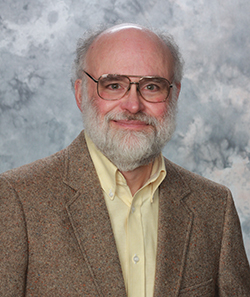
The mortality rate of honey bees has doubled over the past several decades, and it’s largely due to man-made causes, says Dr. Todd Rainey, professor of biology at Bluffton University.
“You’d have trouble watching the news these last few years and not knowing that honey bees are in trouble,” Rainey told a campus colloquium audience Sept. 19.
In past decades, 10-15 percent of honey bee colonies died during the winter months. Today, only about two-thirds of colonies survive the coldest months, he noted.
But the chilly weather isn’t the only reason they are disappearing from their hives, said Rainey, who studied the phenomenon—known as colony collapse disorder—during a 2013 sabbatical.
In fact, honey bees do a remarkable job of staying warm in the winter, he pointed out. Huddling together to form a massive ball around the queen, honey bees generate heat equivalent to a 40-watt light bulb, withstanding temperatures outside a hive as low as 24 degrees below zero, he explained.
However, honey bees are increasingly failing to collect enough nectar and pollen to keep themselves fed in the flowerless months, which Rainey attributes to the industrialization of agriculture. Human expansion and the mass production of crops has pushed bees out of their natural habitat and left them with fewer flowers to forage from, he said.
Growing the same crops across large acreages—a process known as monoculture—is a key cause of this, he told his listeners. Many of the nation’s mass-produced crops, such as corn, aren’t very nutritious for bees, he added.
Additionally, the expansion of housing has uprooted fields of weeds and flowers—where honey bees collect nectar and pollen to use as food—and replaced them with large fields of grass, a plant that Rainey called “practically useless” for the honey bee.
Previously flower-filled land has also been filled with massive orchards, such as those in central California that supply 80 percent of the world’s almonds. Those almond trees only bloom for a few weeks of the year, leaving honey bees with a short window of time to collect nectar and pollen from them, the biologist said.
“We’re farming not only the land, we’re even farming the trees,” he added. “We’re not providing much food for bees.”
The decline of the honey bee population is alarming to the agriculture industry, Rainey said, because honey bees are crucial to the reproduction of trees, flowers and plants on which humans rely.
To ensure a steady supply of almonds, for instance, beekeepers ship thousands of bees—often from across the country—to central California to pollinate the almond trees. “Beekeeping is now commercial. Bees are now livestock,” Rainey said. Bees are also shipped to pollinate other crops, including alfalfa, cherries, blueberries and apples.
Rainey also cited reports from last April that estimate some 80,000 honey bee colonies have been killed in the California almond orchards due to unintentional misuse of pesticides.
But even if the pesticides are properly used, Rainey warned that some of them are carried by the bees back to their hives, exposing them to the harmful chemicals for the rest of the season. This can kill, or at least sicken, the bees, leaving them unable to collect enough food to survive the winter.
Another major danger for bees is infestation of their hives by blood-sucking mites. These parasites accidently transmit disease-causing viruses that can seriously threaten the health of bees. Beekeepers are searching for ways to safely and effectively limit the numbers of these mites in their hives and their spread from one hive to another, Rainey noted.
He suggested that unless something is done to ensure the honey bees are getting enough food to survive, the loss of bees will only increase. “It’s a lot of work to keep a hive going all five flowerless months of the year when there’s no food outside and they’re trying to keep warm,” he said.
Stories Posted This Week
Saturday, October 17, 2026
Friday, October 16, 2026
- Production offers a modern take on the story of St. Clare of Assisi
- Bluffton volleyball edged in 5 by Van Buren
- Pirate girls soccer tie O-G
- October 16 Bluffton Schools athletics lineup, streaming
- Bluffton Council recap: Officers honored for 25 years of service
- Bluffton Clean Up teams up with Troop 3256 Cub Scouts
- Ada FFA: Feeding the Farmers
- Nov. 7 Fall Community Day at Bluffton University
- Quarry Farm Nature Preserve news for Fall 2026
Thursday, October 15, 2026
- DeWine announces $200M Rural Health Transformation program award
- Herb program with Marge Lafollette, Oct. 15
- Prairie seeding activity at Bluffton University, October 24
- Food for thought: Choline for the brain
- Results for 5K on October 2, Bluffton University Homecoming event
- 15 minutes with Sherry Miller, senior center activities coordinator
Wednesday, October 14, 2026
- Ada Icon headlines, October 14
- CANCELLED Main St. closure on October 15
- Frederick Clyde Warren founded True-2-Form Plastics
- Pirate boys soccer beats Wapak in regular season finale
- Pirate girls soccer defeats Liberty Center
- Mennonite pastor to explore ‘good news’ in creation
- Bluffton University earns recognition in U.S. News & World Report rankings
- Obituary for Deborah "Debbie" Welch, 74
- Spirits and exorcism presentation during University Spiritual Life Week Forum
- Dodging bullets: Bluffton oral history 90+ years after Dillinger robbery
- Nora Matthews named BHS Student of the Month for September 2026
- ICAPP analysis on charter status and local autonomy
Tuesday, October 13, 2026
- Ada Icon headlines, October 13
- Bluffton area Women in Business meeting October 15
- Leo club glasses collection
- Night at the (Swiss Historical) Museum, October 24
- Woodcarving ornament workshop at Swiss Heritage Center
- Barefoot nature walks at the Nature Preserve
- Pirate volleyball seeded 4th
- Beavers sports roundup, October 6-11
- Bluffton leaf pickup scheduled for last week of October
- Pirate boys soccer shuts out Bellefontaine
- Watch an after school movie at the Bluffton Public Library