






















Our generation in the covid-19 era

By Fred Steiner
It is a certainty that “The Covid-19 Era” will resonate with us as “The Great Depression” did with our parents and grandparents.
The message “never throw anything away because you never know when you might need it,” is among the what-did-your Depression era grandparents and parents teach their Baby Boomers children?
That Great Depression generation’s continual reminder that things may be great today, but, once upon a time that wasn’t the case, can only mean they experienced something that we know very little about today.
Likewise, the things our generation learns from the 2020-21 experience may make sense to us, but not to those who follow.
Might “stay away from large, close-together crowds” linger forever in our thoughts, a warning making sense to us, while a generation not yet born, will have no clue of our fear of crowds?
Very possibility.
The phrase from a high school Latin class: “There is nothing new under the sun,” fits into this discussion.
In this reoccurring story, covid carries different names and fears reaching previous generations with similar circumstances.
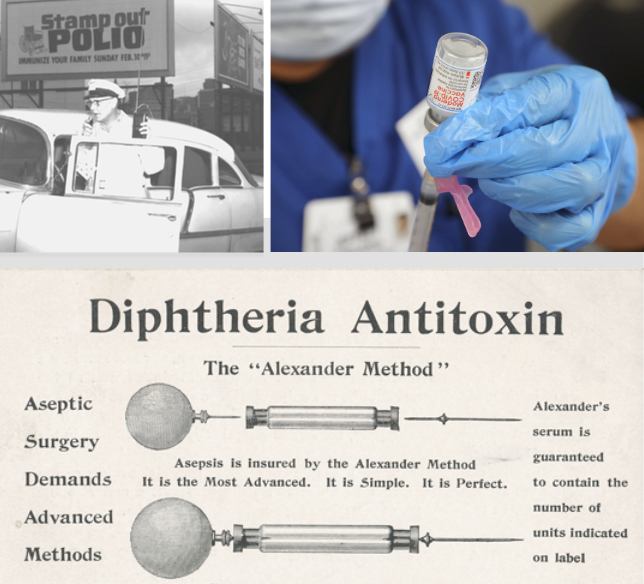
Case in point: I recently learned in a conversation with my older sister of the reason that, growing up in the 1950s, my brother and sister and I never learned to swim. It was because our mother worried that polio could be spread by swimming in Bluffton’s community pool, the Buckeye quarry.
I won’t doubt her fear on this, as perhaps there were other parents with proof or similar notions about this supposed danger.
The following story from 125 or more years ago, offers even more chilling parallels to today’s covid.
This was told to me by my grandfather, Fred Hahn (1876-1961).
In the mid-1880s his parents, Flora and Will, owned a bakery in Forest, a growing village on the northern edge of Hardin County’s Scioto Marsh. Today Forest is part of the Riverdale school district.
A black diphtheria epidemic struck Forest during a mid-1880s winter when my own grandfather was not quite a teenager. Many people died in this small town, in fact, in my grandfather’s version only two people in Forest who contracted it lived. One, coincidentally, was the undertaker’s daughter. The fact that he remembered this certainly must have lingered as an interesting stigma in Forest for years to follow.
Those afflicted had serious breathing problem as the illness affected the nose and throat. Children under 5 and adults over 60 were particularly at risk for contracting the infection. There was no real known cure and probably many theories on its origin.
Once contracting the illness, death often occurred within the week, making it even more tragic.
Treatment for this illness – not necessarily a remedy – was a hot pine tar mixture placed in one’s throat using a long stick by the town doctor who made a daily visit to the homes of the afflicted.
Forest, when struck by this “plague” was actually quarantined from the outside world during that cold winter. No one could enter – or would even want to enter – and no one was allowed to leave.
Men, designated as police deputies, walked the streets day and night, to keep people in their homes. If caught outside you were jailed. A neighbor woman would sneak to the Hahn’s under darkness to help out, offer back rubs to the sick children, so said my grandfather.
A younger sister of my grandfather’s contracted black diphtheria and died within a week.
Her funeral, like others who died, took place on the front porch of the house. The preacher, funeral director and his assistants wore masks. My grandfather recalled watching his sister’s funeral from a window inside the house and was not permitted to attend the burial.
This sounds more and more like 2020 doesn’t it?
Unanswered questions remain:
• What became of the school year?
• How did businesses survive?
• How did resident connect with the countryside and world around them?
• How did the illness arrive in the first place?
• Was there a unified attitude in the community to confront the epidemic, or were their many points of disagreement?
And imagine the isolation – in the coldest season the a 12-month cycle.
The plague, if we can call it that, finally ran its course and the Hahn family, like many other families, immediately moved from Forest. The Hahn’s moved to Ada and set up another bakery.
This Forest black diphtheria experience left Flora “melancholy” the rest of her life, according to my grandfather.
Her set-back was so significant that my grandfather was handed over for a time to another family, to supposedly allow her to recover.
I have a letter my grandfather wrote to his mother about his experiences while not living with his parents. It tells of the day-to-day experiences of a pre-teen boy living apart of his family following a tragic set of circumstances out of his control.
The Forest story reminds us that our current experiences are not in any way unique, which may come as a surprise to our 2020 generation.
It’s so easy to imagine that we are the first to ever witness a covid experience. We aren’t.
The covid era of 2020-21 shaping the rest of our lives is a reoccurring story in human history, and the Forest story is just one example.
To paraphrase Clarence Darrow, “One thing wrong with history is that it repeats itself.” Our generation’s historical repeat will mark our lives for many years, despite our well-intended efforts, reminding us that there is nothing new under the sun.
Stories Posted This Week
Saturday, October 17, 2026
Friday, October 16, 2026
- Production offers a modern take on the story of St. Clare of Assisi
- Bluffton volleyball edged in 5 by Van Buren
- Pirate girls soccer tie O-G
- October 16 Bluffton Schools athletics lineup, streaming
- Bluffton Council recap: Officers honored for 25 years of service
- Bluffton Clean Up teams up with Troop 3256 Cub Scouts
- Ada FFA: Feeding the Farmers
- Nov. 7 Fall Community Day at Bluffton University
- Quarry Farm Nature Preserve news for Fall 2026
Thursday, October 15, 2026
- DeWine announces $200M Rural Health Transformation program award
- Herb program with Marge Lafollette, Oct. 15
- Prairie seeding activity at Bluffton University, October 24
- Food for thought: Choline for the brain
- Results for 5K on October 2, Bluffton University Homecoming event
- 15 minutes with Sherry Miller, senior center activities coordinator
Wednesday, October 14, 2026
- Ada Icon headlines, October 14
- CANCELLED Main St. closure on October 15
- Frederick Clyde Warren founded True-2-Form Plastics
- Pirate boys soccer beats Wapak in regular season finale
- Pirate girls soccer defeats Liberty Center
- Mennonite pastor to explore ‘good news’ in creation
- Bluffton University earns recognition in U.S. News & World Report rankings
- Obituary for Deborah "Debbie" Welch, 74
- Spirits and exorcism presentation during University Spiritual Life Week Forum
- Dodging bullets: Bluffton oral history 90+ years after Dillinger robbery
- Nora Matthews named BHS Student of the Month for September 2026
- ICAPP analysis on charter status and local autonomy
Tuesday, October 13, 2026
- Ada Icon headlines, October 13
- Bluffton area Women in Business meeting October 15
- Leo club glasses collection
- Night at the (Swiss Historical) Museum, October 24
- Woodcarving ornament workshop at Swiss Heritage Center
- Barefoot nature walks at the Nature Preserve
- Pirate volleyball seeded 4th
- Beavers sports roundup, October 6-11
- Bluffton leaf pickup scheduled for last week of October
- Pirate boys soccer shuts out Bellefontaine
- Watch an after school movie at the Bluffton Public Library
- Dunlap awarded OSBA humanitarian award