






















Bluffton honor code in the world


At Bluffton University, students are held to a distinct system of accountability, one that permeates not only academic integrity, but all aspects of community life.
Bluffton is one of just 100 or so colleges and universities in the United States with an honor code.
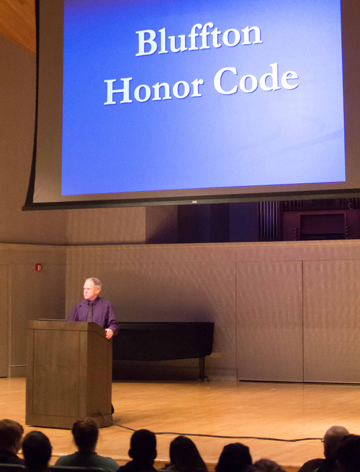
Dr. Mark Bourassa, assistant dean of students, examined the historical context of honor codes in the United States as well as at Bluffton during the Nov. 14 Forum, “Bluffton’s Honor Code in the World.”
“Honor codes don’t work when they are simply sitting on the shelf,” explained Bourassa. “They work best when we continually seek to engage with each other in understanding the shared values that are embedded in our community.”
Bluffton is seeking out these conversations through the use of its annual Civic Engagement Theme. The 2017-18 theme, “Integrity, Truth, Virtue: Bluffton’s honor code in the world,” celebrates the 100th anniversary of its beginnings at Bluffton in 1918. During the academic year, the campus community is exploring Bluffton’s legacy of honor on campus.
Upon coming to Bluffton 27 years ago as an admissions counselor, Bourassa found a friendly, welcoming and trusting community. “Aspects of this environment were new to me and I found myself drawn to seeking an understanding of what was different about the Bluffton community. One unique aspect that was new to me was this idea of an honor system.”
Bourassa was so intrigued by the honor code that he further studied honor systems while seeking a master’s degree from Bowling Green State University. They were also part of his doctoral research at the University of Toledo on academic integrity at church related colleges.
According to Bourassa, honor codes came about during the Colonial era when “the values of self-reliance, self-governance and acting honorably were emphasized.” In 1779, the first honor code on a college campus was established at the College of William and Mary with a pledge to not lie, steal or cheat.
H.W. Berky, chemistry professor, brought the concept of honor codes to Bluffton from his undergraduate studies at Princeton University, which had also adopted an honor system.
In his research, Bourassa questioned Bluffton alumni on their experiences with the honor code. Responses included the following statements:
”The honor system gives me the sense that we are all looking out for each other. Taking care, so that others around you don’t falter. Like in a family.”
“The honor system exemplifies the values and illustrates to students the kind of person the college would like to see them become.”
In the fall of 2010, however, the Bluffton University Student Senate began a dialogue about the honor system.
“While supportive of the system,” explained Bourassa, “they were concerned that the university community was not taking it seriously enough.”
Concerns ranged from faculty remaining in the exam room even when they were not overtly “proctoring” to a lack of consistency when a pledge was left unsigned.
A task force of students, faculty and staff looked into the issues and recommended changes and clarification on all issues raised including extending the pledge to all assignments.
“In the end, the whole campus renewed its commitment to the honor system and its principals as a vital component of Bluffton’s culture and community,” Bourassa said.
So, do honor codes actually work? Bourassa believes they do. “Studies have shown that cheating at school with honor codes is less.” He added that there is less research on the civic/social responsibility side of honor codes, but “it’s all about creating a culture of responsibility and accountability and promoting fundamental values.”
However, there are several characteristics needed for an honor code to succeed, including:
• Clearly stated objectives and expectations
• Fully involved students, faculty and staff in the administration and maintenance of the system
• An orientation of community members to the concept
• Active reduction of temptations
• Strict, yet reasonable, penalties for code violations
• A shared culture of common beliefs and assumptions
Bourassa ended his presentation with a quote from a commentary on honor codes by Jennifer Dirmeyer and Alexander C. Cartwright in the Chronicle of Higher Education. “When it works, the culture makes for a successful honor code as much as the honor code makes for a successful culture.”
Stories Posted This Week
Thursday, October 8, 2026
- Ada Icon headlines on Thursday, October 8
- St. John Bible Church to host "Refocus on Purpose" workshop
- Royal riches: Gout
- October 8 Bluffton Schools athletics lineup, streaming
- Has Bluffton made a birder out of you?
- BPL Afterschool activity: Curious Kids Club
- Book and pizza tasting at Bluffton Public Library
- Final 50 for 250 performance at BPL
- Walking through the Suter Corn Maze
- Resident feedback sought for Regional Transportation Plan
- Bluffton University honors three for service, achievement and leadership
Wednesday, October 7, 2026
Tuesday, October 6, 2026
- Bluffton Area Chamber of Commerce monthly meeting, Friday, Oct. 9
- Fire extinguished at SRK Industries, plant resumed operation same day
- Bluffton girls tie Grove in NWC showdown
- Pirate volleyball falls to powerhouse Patriots
- BHS GOAT: Latin teacher Margaret Weaver
- Library patrons invited to showcase their collections or causes
- September 2026 land transfers in the Bluffton school district
Monday, October 5, 2026
Sunday, October 4, 2026
- Bluffton Fire Dept. extricates passenger following I-75 crash
- Crumrine leads October 8 Watercolor Workshop
- MCHO opportunities to trick or treat, donate candy
- ALA Banned Books Week
- Pirate boys soccer blanked by Celina
- Hancock Public Health confirms measles case in Findlay
- Timeline for October 10 Dillinger robbery reenactment and motorcycle show