




















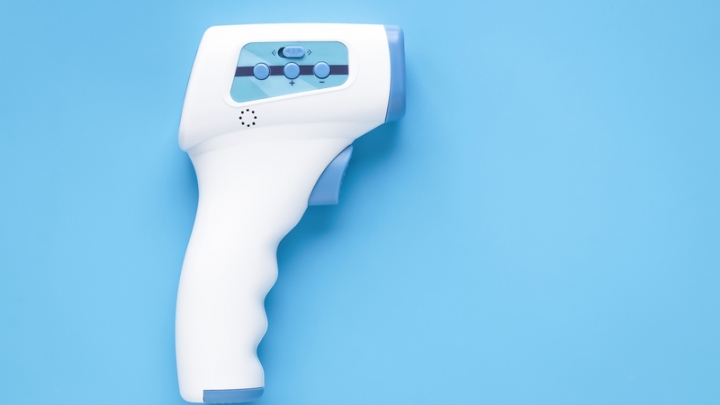
Non-contact thermometers

This article provided by Ohio Northern University HealthWise Pharmacy.
As businesses and individuals have begun taking extra precautions during the COVID-19 pandemic, non-contact thermometers have become more common. Here's what you need to know about these devices.
Because the coronavirus can be spread through contact with others, many health care facilities and businesses have begun screening for symptoms using methods that cause as little contact as possible.
An elevated temperature is one of the early warning signs of COVID-19 infection, so non-contact thermometers provide a safer way of screening people for possible coronavirus symptoms.
Pros and Cons of Non-Contact Infrared Thermometers
Non-contact infrared thermometers (NCITs) come with some benefits and limitations. According to the US Food and Drug Administration (FDA), these are some of the benefits of using NCITs to measure temperatures during the COVID-19 pandemic:
The non-contact method may decrease the likelihood that the virus will spread from person to person.
NCITs are easy to use and clean.
Temperatures are taken and displayed quickly.
On the other hand, these thermometers come with some limitations:
Although NCITs limit contact between people, these devices still require somewhat close contact, which means the virus can still possibly spread.
The temperature measurement can be affected by the placement of the device and how it is used.
How to Use an NCIT
If you have an NCIT or are planning to use one to measure your temperature, always follow the manufacturer's guidelines for your specific device.
Generally, however, you will need to use the thermometer in a space that is away from radiant heat sources and direct sunlight. To properly use an NCIT, the environmental temperature should be between 60.8 and 104 degrees Fahrenheit, according to the FDA. And the relative humidity should be below 85 percent.
The thermometer needs to adjust to the environment before use. That's why it's important to place the NCIT in the room it's going to be used in for ten to 30 minutes before use, the FDA noted.
Directly before using the NCIT, make sure the forehead is clean and dry. The person being tested should not wear headbands or other head coverings during or before testing.
Here are some general steps to take when using an NCIT:
Hold the sensing area perpendicular to the subject's forehead. (The person being tested must remain still during the test.)
Check your device's instructions to learn the proper distance to hold the NCIT from the forehead. Follow that direction exactly.
Keep the NCIT's sensor dry and clean, and do not touch the sensing area.
If you are concerned that you may have COVID-19 or another illness, contact your health care provider.
Stories Posted This Week
Wednesday, October 14, 2026
- Ada Icon headlines, October 14
- CANCELLED Main St. closure on October 15
- Frederick Clyde Warren founded True-2-Form Plastics
- October 14 Bluffton Schools athletics lineup, streaming
- Pirate boys soccer beats Wapak in regular season finale
- Pirate girls soccer defeats Liberty Center
- Mennonite pastor to explore ‘good news’ in creation
- Bluffton University earns recognition in U.S. News & World Report rankings
- Obituary for Deborah "Debbie" Welch, 74
- Spirits and exorcism presentation during University Spiritual Life Week Forum
- Dodging bullets: Bluffton oral history 90+ years after Dillinger robbery
- Nora Matthews named BHS Student of the Month for September 2026
- ICAPP analysis on charter status and local autonomy
Tuesday, October 13, 2026
- Ada Icon headlines, October 13
- Bluffton area Women in Business meeting October 15
- Leo club glasses collection
- Night at the (Swiss Historical) Museum, October 24
- Woodcarving ornament workshop at Swiss Heritage Center
- Barefoot nature walks at the Nature Preserve
- Pirate volleyball seeded 4th
- Beavers sports roundup, October 6-11
- Bluffton leaf pickup scheduled for last week of October
- Pirate boys soccer shuts out Bellefontaine
- Watch an after school movie at the Bluffton Public Library
- Dunlap awarded OSBA humanitarian award